"One-time payment, own it forever" 10% off ! discount code -excl10

Accurate Trading Signals That Actually Help
Learn what accurate trading signals really look like, how to avoid false setups, and how traders use cleaner confirmation to act faster.
3/21/20266 min read
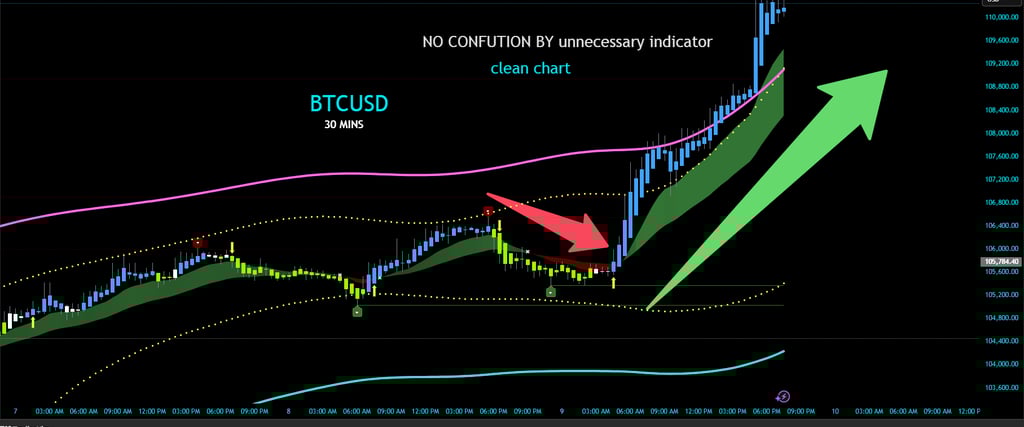
Most traders are not losing because they lack effort. They are losing because they are reacting to messy charts, late entries, and signals that look great until the candle closes. That is why accurate trading signals matter so much. A good signal does not just point at a possible move. It helps you make a faster, clearer decision without second-guessing every candle.
The problem is that “accurate” gets thrown around way too easily in trading. Plenty of tools promise sniper entries, near-perfect win rates, or instant profits. Then you load them onto a chart and realize the signals repaint, fire too often, or ignore the market context that actually matters. That is not accuracy. That is noise with good marketing.
If you trade Forex, crypto, or stocks on TradingView, the real goal is not finding a magic arrow. It is building a cleaner decision process. Strong signals can absolutely help with that, but only when they are built around confirmation, structure, and timing.
What accurate trading signals really mean
Accurate trading signals are not signals that win every time. No real trader believes that. Accuracy in trading is about consistency, reliability, and context. A useful signal appears for a reason you can trust, not because the chart is crowded with conditions that only look good in hindsight.
A strong signal should help answer three questions fast. First, is there a real setup here? Second, is this the right time to enter or wait? Third, where does the idea break if the market moves against you?
That is why experienced traders care less about flashy alerts and more about signal quality. A signal becomes more valuable when it lines up with trend direction, support and resistance, momentum, and price behavior around key levels. If it ignores those things, accuracy usually falls apart when the market gets volatile.
Why most signals fail in live markets
A chart can look amazing in a screenshot. Live trading is where the truth shows up.
Many indicators fail because they are too sensitive. They react to every small move and flood the chart with entries that have no edge. Others are too slow, which means the signal appears after most of the move already happened. At that point, traders are entering late and managing poor risk from the start.
Repainting is another major issue. A signal that changes or disappears after the fact gives traders fake confidence. It makes past performance look stronger than real performance. If you want dependable entries, non-repainting logic matters a lot. That is exactly why traders spend time learning What Makes a Non Repaint Trading Indicator. If a signal cannot stay honest after the candle closes, it should not be trusted with real money.
The other reason signals fail is simple. Traders use them in isolation. Even a high-quality signal can struggle if you take every alert in a ranging market, every breakout into resistance, or every buy against a strong downtrend.
The traits of more accurate trading signals
The best signals are not usually the loudest. They are the clearest.
First, they are built to reduce noise. That means fewer low-quality alerts and more focus on conditions that actually matter. When a tool gives you constant triggers, it often feels productive, but more signals do not mean more profit. In many cases, they mean more bad trades.
Second, they respect market structure. If price is rejecting a major resistance zone, breaking trend, or failing to hold support, a smart signal should reflect that. Structure gives meaning to the entry. Without it, the signal is just guessing.
Third, they help with timing. This is huge. Many retail traders can spot direction but still enter too early or too late. A better signal closes that gap by identifying moments where momentum, location, and trend are aligned. That is where decision speed improves.
Fourth, they are easy to read. Simple does not mean weak. In fact, traders often get better results when the chart is cleaner. A tool that combines entries, exits, support and resistance, and momentum cues in one streamlined view can help traders act with more confidence and less hesitation.
Why confirmation matters more than prediction
Here is the truth most traders learn the hard way. Prediction is overrated. Confirmation is what keeps you in the game.
Trying to call every top and bottom sounds exciting, but it usually leads to forced trades. More accurate trading signals work better when they confirm what price is already showing. That might mean a breakout above a level with trend support, a reversal from an oversold zone with bullish momentum, or a continuation setup after a pullback into structure.
This is why layered analysis beats one-dimensional analysis. A signal is stronger when it confirms a story the chart is already telling. For example, overbought and oversold channels can help filter entries when momentum is stretched. If you want to sharpen that part of your process, Overbought Oversold Indicator TradingView Tips can help you read those conditions more effectively.
Professional-style decision-making is not about finding one perfect indicator. It is about combining the right clues fast enough to take action with discipline.
How to judge signal accuracy without fooling yourself
A lot of traders test indicators the wrong way. They scroll backward, find perfect examples, and assume the tool is elite. That is hindsight bias, and it is expensive.
A smarter approach is to watch how signals behave candle by candle. Do they appear at logical areas? Do they stay fixed after the bar closes? Do they align with the broader trend, or do they keep firing against strong momentum? Most importantly, do they improve your process, not just your excitement?
You also need to track results by market condition. Some signals do better in trends. Others work better in ranges or after strong pullbacks. There is no universal tool that dominates every environment. Traders who understand that usually outperform traders who keep hunting for perfection.
It also helps to judge a signal by risk quality, not just win rate. A setup with a moderate win rate but clean entries and strong risk-to-reward can be far more useful than a tool that wins often but leaves no room for smart trade management.
Accurate signals need structure behind them
If you want better setups, stop treating signals like random alerts and start treating them like structured opportunities.
Support and resistance zones matter because they show where price is likely to react. Breakout levels matter because they show where momentum may expand. Overbought and oversold conditions matter because they help you avoid chasing stretched moves. Entry and exit logic matters because timing changes everything.
When those pieces work together, signal quality gets stronger. That is why many traders prefer tools that do more than print arrows. They want a system that gives context. They want to know where price is, what it is doing, and whether the move has room to continue.
For traders who struggle with timing, How an Entry and Exit Indicator Helps is a useful next step. Entry quality is important, but exits often separate decent traders from consistent traders.
What beginners and intermediate traders should do differently
Beginners usually make one of two mistakes. They either trust every signal blindly, or they distrust every tool after a few losses. Both reactions miss the point.
A beginner should use signals as guided decision support, not as a substitute for judgment. The goal is to make chart reading easier and faster while learning why a setup makes sense. When a signal lines up with trend, structure, and momentum, that is where confidence starts to build.
Intermediate traders often have a different problem. They know enough to analyze the chart, but they still hesitate, overcomplicate entries, or stack too many indicators. For them, accurate signals can act as a filter. Instead of analyzing ten conflicting tools, they can focus on fewer, cleaner confirmations and act faster when the setup is there.
That is one reason algorithmic chart tools have become so popular with active traders. They reduce scanning time and help surface higher-probability setups quicker. If speed and clarity are a big part of your trading goals, Algo Trading for Faster, Smarter Setups is worth reading.
The real advantage is confidence with discipline
Let’s keep it real. Accurate trading signals do not remove risk. They do not eliminate losing streaks. They do not guarantee profits.
What they can do is give you a cleaner process. They can help you stop forcing trades, stop chasing late moves, and stop getting buried under indicator overload. That alone can change the way you trade.
The best tools support discipline. They help you wait for stronger setups. They help you see structure faster. They help you make decisions with less emotional noise. That is a real edge.
For retail traders, that edge matters even more because time, focus, and confidence are limited resources. If your chart setup helps you read the market within minutes instead of fighting confusion for an hour, you are already trading smarter.
The bottom line is simple. Accurate trading signals are not about fantasy-level precision. They are about honest signals, strong confirmation, and better timing. When your tools are built to support real decisions instead of selling false certainty, your whole trading process gets sharper. That is where better habits start, and better habits are what put you in position for better trades.
Enhance your trading with our NON REPAINTED premium indicators !
© 2026. TRBO algo .All rights reserved.
DISCLAIMER:Trading carries significant risks and may not be suitable for all investors. Leveraged trading has the potential to magnify both gains and losses, making it crucial to comprehend the risks associated with trading on margin fully. The information provided by TRBO Algo is intended for informational purposes only and should not be considered as financial advice. We strongly advise seeking guidance from qualified financial professionals before making any investment decisions.It is essential to recognize that trading outcomes are not guaranteed and carry inherent risks. By using our products and services, you agree that TRBO Algo will not be liable for any losses or damages that result from your investment choices. This disclaimer serves to clarify that we do not make any assurances or guarantees regarding investment success or profitability. You acknowledge and assume full responsibility for all trading decisions you make.